





描述
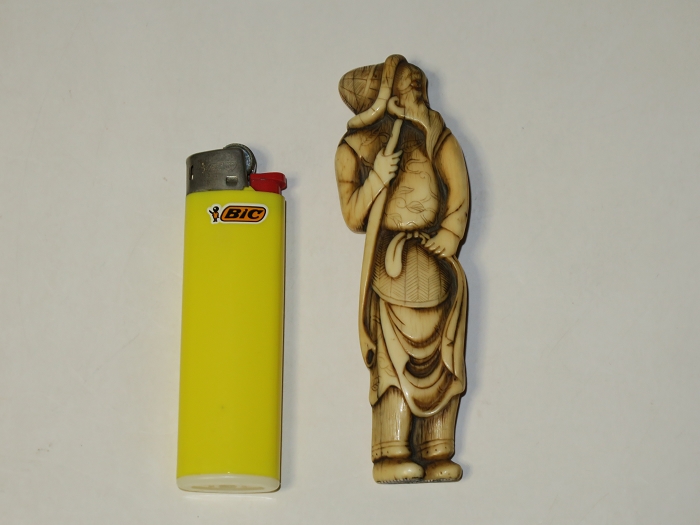
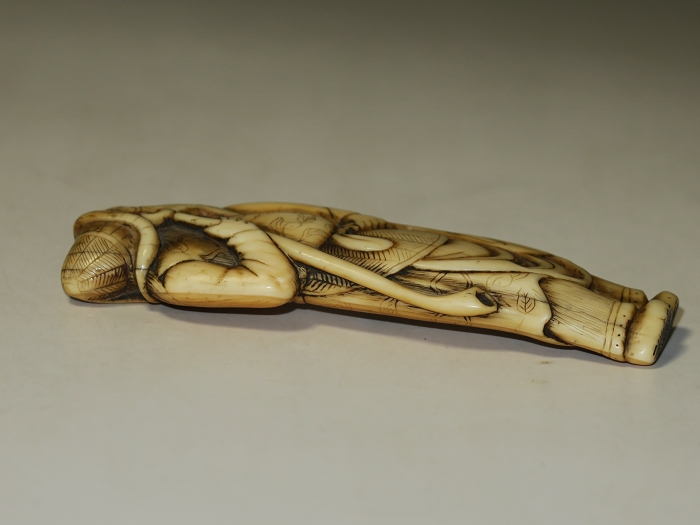
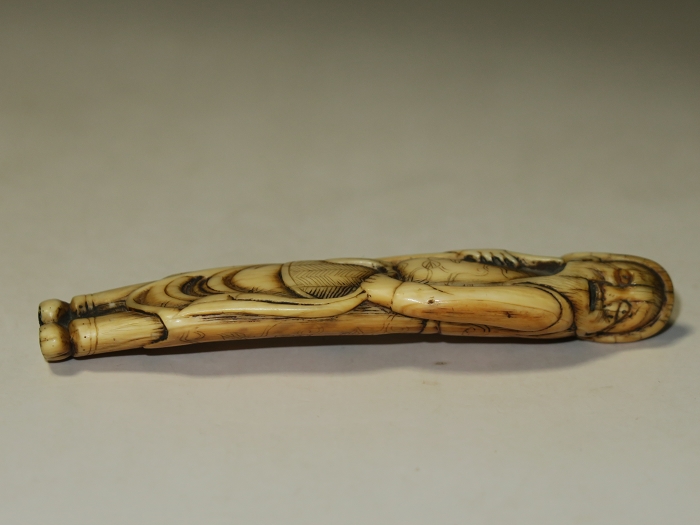
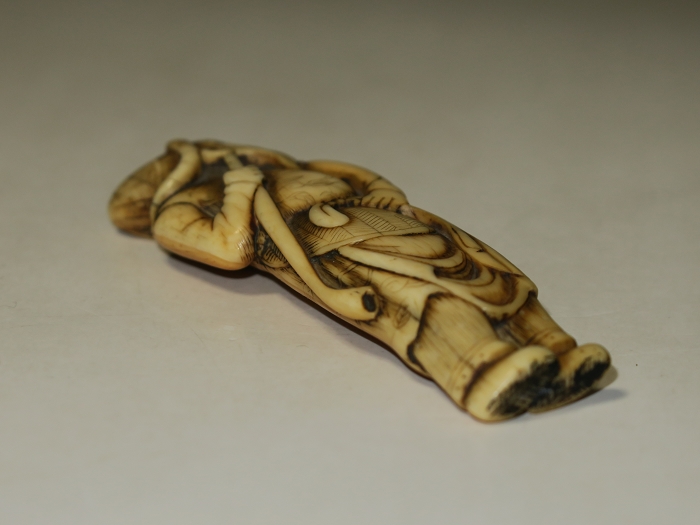
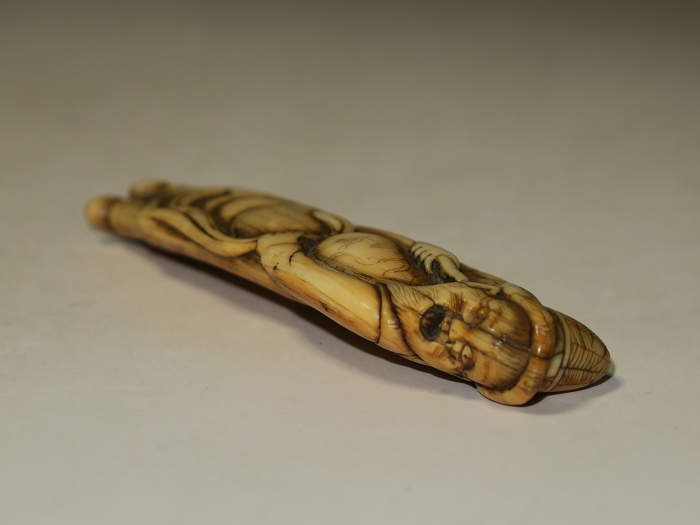
荷兰人呈站姿右倾,手握长笛,表情悲伤。一另手握住一根滚动的和服下摆。和风长袍上刻有精细云草纹,外套穿在马裤外,上刻碎波和云朵。宽大的帽子上刻有花卉和羽毛。凝视远方,思念乡愁。
与关西派“红毛人”抱鸡牵獏之类虽然高价但存世量多的丑化风格大相径庭,此件中荷兰人无论表情造型衣着均栩栩如生,据此断定为长崎本地根付师原创的定制品。
江户幕府闭关锁国,外国人不得进入日本。唯有中国人和荷兰人例外,可以仅限在长崎居住和从事贸易。荷兰人未经允许离开长崎者斩立决,至于中国人,暂未发现相关规定。
严酷的法律导致荷兰人极少有机会离开长崎,同样,长崎以外的日本人也很难有机会见到荷兰人的“实物”。荷兰人离开长崎的理由基本仅限于“上京(都)”为皇亲贵族治病,由于长相怪异,加之见者极少,故以讹传讹,被称为“红毛人”。
在长崎以外的日本人印象中,传说中的红毛人属于怪物。对于根付师匠而言,这显然是绝佳卖点。但红毛人的举动不明,既然是怪物,肯定有别于常人。因此存世的红毛人题材根付要不怀抱鸡,要不牵着獏以及类似的传说中的怪兽,行为怪诞,造型异于常人。
此件罕见附有内外牙皮,外皮顾名思义,是象牙最外层的皮,几乎无牙纹。内皮牙纹粗大疏松,因此雕刻时通常提前剥除牙皮,仅使用质地坚硬越润泽度高的“肉牙”。此件连皮带肉,纹理纵向略呈波浪形,采用“拨镂”工艺,实属难得。
唐代象牙雕以实用器为主,主要采用“拨镂”工艺。拨镂又称“平刻”,传自唐代牙雕工艺:用刻刀在打磨光滑的象牙表面浅刻,用刀依书法,构图依画论,艺术水平极高。日本牙雕受此法影响极深,无论人物圆雕乃至服饰衣纹,沿用至今。


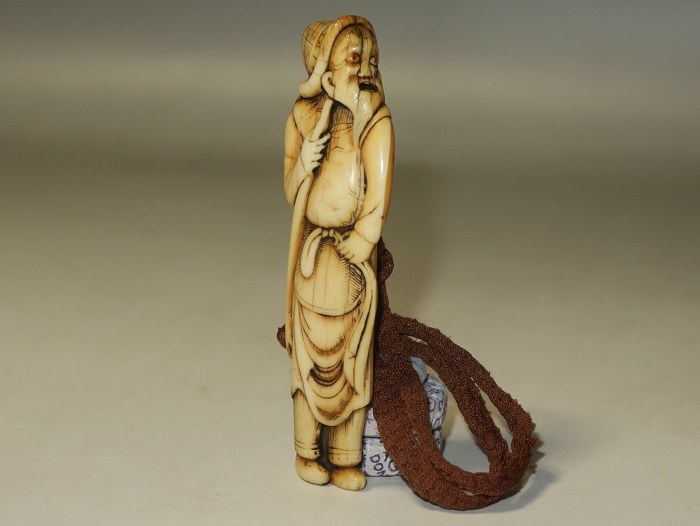


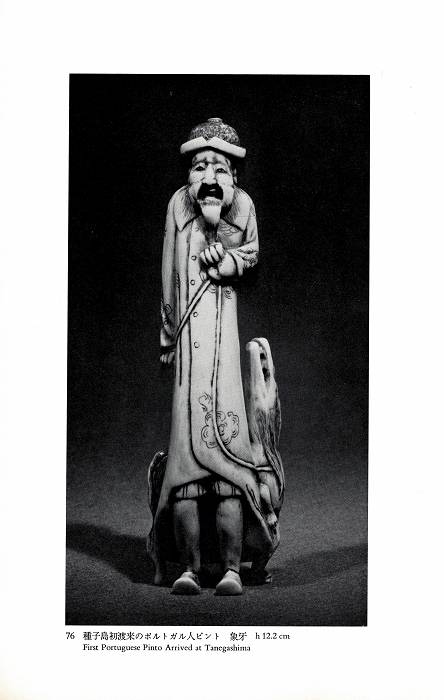
参考:大英博物館蔵根付圖錄「NETSUKE- The Miniature Sculpture of Japan」P157(№355)
根付展—NETSUKE圖版P176),日本経済新聞社主催(外務省、文化庁、美國大使館後援),1981年5月
IVORY NETSUKE OF A FOREIGNER—Dutchman missing homesick,head turned to one side.
Edo period (1615-1868), late 17th century
Nagasak school
Unsigned
Carved ivory, with inlaid eyes
9.5cm high.
the ivory with a good patina.
Provenance:Vienna private collection, purchased from London, 1957.
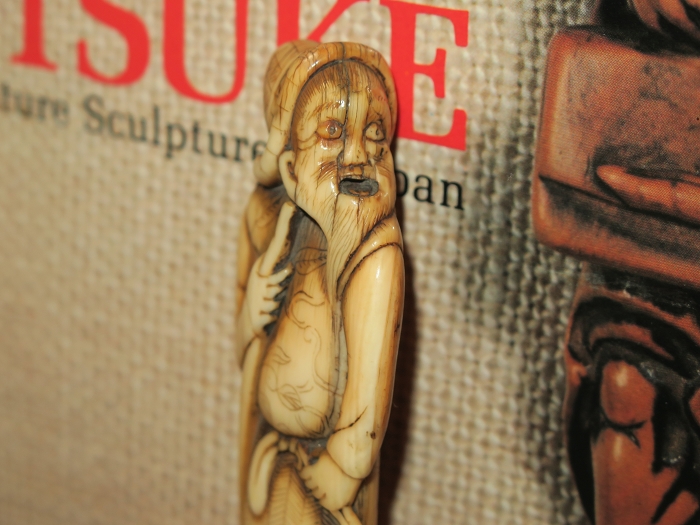
Standing, turning to the right, his slender body slightly twisted.holding his flute with one hand and a rolled makimono (handscroll). his robe engraved with scrolls formal designs. his coat, worn over fur breeches and carved with breaking waves and clouds. his broad hat carved with a floral plume.Staring into the distance, missing Homesick.
Often the portrayal of Dutch merchants in netsuke has resulted in somewhat grotesque figures, attenuated and lifeless.The manners and mores of foreigners, which to the Japanese meant Europeans, particularly the Portuguese, sometimes the Dutch, were often ridiculed in netsuke.NETSUKE with a serious foreigner theme is very rare,The style of carving is one that has been attributed by carvers from Nagasaki in Kyushu.

Netsuke were made in a variety of forms, the most widely appreciated being the katabori (shape carving), a three-dimensional carving, such as this one in the form of a figure in European dress.
In 1543 the Portuguese arrived in Japan, followed by the Spaniards, Dutch and English. This resulted in an enormous interest in people with different physical characteristics, clothing, customs and accoutrements.
By 1641, however, all Europeans had been expelled from Japan. The only exception was the Dutch, who were allowed to trade from the island of Dejima. The fascination with Europeans nevertheless continued, manifesting itself in the carving of figural netsuke with Western features during the late 17th and 18th centuries.
These often presented a fusion of the many outside influences in Japan from the 16th century onwards, resulting in rather inaccurate depictions of foreigners. This particular netsuke of a Chinese or Japanese figure in contemporary European dress is a typical example.
In the 18th century, Japanese craftsmen made netsuke in the form of standing European figures. like this Dutchman. These netsuke were made at a time when Japan was virtually closed to Europeans.
The netsuke carvers seem to have based their European faces on a type of doll known as Saga ningyo (Saga doll). The other source was prints and paintings of foreigners produced in Nagasaki.

MEIGETSU CO., LTD is one of the leading international art dealers specializing Chinese, Japanese, himalayan art and CURIOSA(erotique art), As a regular member of JADAN (Japan Art Dealer Association),We guarantee all artifacts to be genuine as described. It is our policy never to deliberately list fakes as genuine. All art listed will always stated as such.

If you are looking for Netsuke or syunga, we offers a top quality selection at fair prices. More importantly I am expert in EAST ASIATIC COLLECTION OF CHINESE AND JAPANESE field and will unselfishly help & guide you with the upmost integrity.

We believe art has the power to transform lives and to build understanding across cultures.We believe that the brilliant histories of art belong to everyone, no matter their background.


Please make sure with your country’s customs before making an order that. The Japanese Antiques can be imported into your country without a problem. We do not take any responsibility, including (not limited to) refund, due to the above reasons.

There is no responsibility for us regarding “customs duty”, “consumption tax”, etc. according to the law of the country of the shipping destination,Import duties and taxes not included in the item price or shipping cost.These charges are the buyers responsibility. Please check with your countrys customs office to determine what these additional costs will be prior to buying.


评论
目前还没有评论